Dan Lok

Why Athletes Retire at 35 (And Entrepreneurs Die at Their Desks)

Open up Instagram right now and search for the hashtag #Entrepreneur.

You will see rented Lamborghinis. You will see private jets. You will see twenty-two-year-olds drinking champagne on yachts in Dubai, claiming they cracked the code to “money while you sleep.”

It is a complete hallucination.

It is the furthest thing away from the brutal reality of actual entrepreneurship.

For years, my reality wasn’t a yacht. It was sitting alone in a dark room, staring at a computer screen at 2:00 AM, dealing with a mountain of unknowns and absolute uncertainties.

When I first started out, the weight was crushing. Everything fell directly on my shoulders. I would lie awake staring at the ceiling, paralyzed by the thought of making payroll.

I obsessed over cash flow, financing, and adapting to industry changes that constantly threatened to wipe me out.

Then, I finally figured it out. The business became successful.

But the stress didn’t go away. It just mutated.

I had to worry about scale. I worried about hiring the right talent and managing the wrong talent. And when I reached the peak – when I became more successful – I was greeted by haters, predators, and trolls.

My best employees were constantly being recruited by rivals. I realized that I was personally responsible for the livelihoods of dozens, then hundreds, of families.

It was an incredibly heavy burden.

And the cruelest joke of all? 

When I had finally “made it,” there were days I just felt empty. I would look at the empire I built, lose my motivation, and wonder what the actual meaning of it all was. I was accumulating more wealth, but inside, I felt completely hollow.


The Robin Williams Paradox

The hardest part about this decades-long mental assault was that I couldn’t really talk to anyone about it.

Family simply doesn’t understand the psychological cost. If I tried to share my wins with my friends, I held back because I was afraid they would think I was bragging. If I shared my deepest business challenges, their eyes would glaze over.

So, I put on a mask.

I would walk into the office, jump on a Zoom call, and project absolute confidence. I became a professional actor, manufacturing confidence and security for everyone around me, while internalizing all the chaos myself.

This is exactly why comedians like Robin Williams suffered so deeply. They spend their entire lives figuring out how to make the whole world smile, while breaking apart inside. Entrepreneurs do the exact same thing.

But here is the brutal truth: The body keeps the score.

Because I was internalizing all that pressure, I turned to the easiest coping mechanism available. I poured every ounce of my energy into the business, and I completely neglected my physical body.


Falling Asleep at the Red Light

My father was a loud snorer. When I was a kid, I could literally hear him from the other room. I thought it was just a normal trait I inherited.

About 9 years ago, Jennie’s mother was in the hospital. We were sitting in the waiting area, completely exhausted, when I looked up and saw a poster on the wall about Sleep Apnea.

It read:

Do you suffer from…

  • Loud snoring?
  • Morning headaches?
  • Dry mouth?
  • Waking up tired?
  • Falling asleep while working or watching TV?

I stared at the poster and muttered, “Shit. I have all of these.”

I had even fallen asleep once or twice while waiting at a red light in traffic. It was incredibly dangerous, but I had just brushed it off as being a “hardworking, exhausted entrepreneur.”

Jennie looked at me. “Dan, you snore like thunder. You need to go get tested.”

I listened to her. I brought a little testing machine home from the clinic, and the results were shocking. I suffered from severe sleep apnea. I was having 30+ “incidents” per hour where I would literally stop breathing in my sleep. The doctor explained that this was exponentially increasing my risk of stroke, high blood pressure, and heart disease.

I got a CPAP machine immediately. It completely changed my life. I started waking up fresher, with razor-sharp focus and boundless energy. Today, I cannot sleep without it.


The Multi-8-Figure Relapse

You would think almost falling asleep at a red light would be the ultimate wake-up call. But the business kept pulling me back into the chaos.

A few years ago, we were scaling to multiple 8-figures. It was a period of insane, violent growth. I was dealing with the most complex employee problems I had ever faced. And under that immense pressure, I relapsed right back into my old habits.

I stopped exercising. I ate late every single night. I was basically using food to numb the stress – snacking and drinking sugary drinks all day while glued to my desk.

My weight became a massive yo-yo. There were years when I exercised a lot, but when work got crazy, I would balloon up, eat too much, and not step foot in a gym for a year.

I felt fine. Or at least, I lied to myself that I did.

Then, a very good friend of mine recommended a private clinic. I hadn’t had an annual check-up in years because I was “too busy.” I finally went in for a full exam.

A few days later, my phone rang. It was the doctor.

“Dan, you need to come in immediately.”

I sat in his office as he went through my chart. I was diagnosed with Type 2 Diabetes. Every single metric was in the red. My cholesterol was high, my sugar levels were out of control, my body fat was entirely too high, and my bone density was poor.

I was in absolute shock. The doctor looked me dead in the eye and gave me a very clear warning: if I continued down this path, I was simply not going to live very long.

Left: 30 lbs heavier, running on pure stress, and trading my health for net worth. 

Right: 30 lbs lighter, optimized, and treating my body like my greatest asset.


The Ultimate Compounding Asset

That was the moment I realized the fatal flaw in how entrepreneurs are wired.

Think about a professional athlete. They compete at an elite physical level, and most of them are forced to retire in their 30s. Their careers are finite because the physical toll is simply too high. No one expects a professional linebacker to compete into his 50s.

But for business owners? We carry a massive, compounding mental and emotional toll, yet we are expected to just keep grinding into our 60s and 70s

The culture doesn’t celebrate quitting. You make a million, you go make $10 million. You make $10 million, you aim for $50 million. You hit $100 million, and now you have to aim for a billion.

It never stops. We constantly move the goalposts, but we refuse to upgrade the vehicle carrying us there.

After I turned 40, I took the doctor’s warning seriously. I realized that if I wanted to carry the weight of a Certainty Capitalist, I had to stop treating my body like a garbage disposal.

I radically changed my eating habits. I hired a private nutritionist. I hired a fitness coach who works out with me personally. I started taking precision supplements and doing comprehensive blood work every single quarter.

Today, at the age of 44, I recently got my results back.

My doctor told me the biological age of my body is 36.

I can move better, I have far more endurance, and I am physically stronger today than I was in my 30s.

We spend all our time obsessing over our real estate portfolios, our stock portfolios, and our business equity. But we forget one absolute truth:

Health is your ultimate asset.

Think of your body like a high-yield bank account. Every time you choose to eat something healthy, every time you push through a hard workout, it is not a chore – it is a deposit. It compounds. And it will pay massive dividends when you get older.

You cannot scale your business without scaling you.

Dan Lok 

Certainty Capitalist™
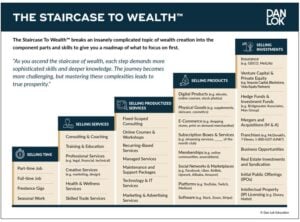
The Staircase to Wealth™: The Step-by-Step Roadmap to Millions and Billions

“You dirty, rotten, good-for-nothing!”

My manager’s voice echoed down the sterile, fluorescent-lit aisle, practically rattling the canned goods on the shelves. I was on my hands and knees, picking up a shattered glass jar and wiping sticky, foul-smelling liquid off the linoleum floor.

I was working as a grocery bagger in a local supermarket. I stocked cans, bagged groceries, checked inventory, and when management felt like putting me in my place, they ordered me to scrub the public toilets.

It was my first job. And it was the only real job I have ever had.

Because exactly at that moment, kneeling in a puddle of a mess someone else made while a man in a cheap tie screamed at me, I learned a profound truth about my own DNA: I am fundamentally unemployable.

I refused to let another human being dictate my worth, my schedule, or my dignity. I never wanted to work for anyone ever again.

Most entrepreneurs share a similar origin story of frustration. But here is the problem: when people finally decide they want to get rich, they look at billionaires like Elon Musk, Warren Buffett, or the titans on Wall Street, and they try to copy what those men are doing today

They try to launch a massive software platform, build a venture fund, or syndicate a complex real estate deal with absolutely zero actual business skills.

They try to jump straight to the top of the ladder. And they shatter their legs on the way down.

Wealth creation is not a lottery ticket. It is a systematic, brutal progression of skill acquisition. I developed a framework called The Staircase To Wealth™

The Staircase To Wealth™ breaks an insanely complicated topic of wealth creation into the component parts and skills to give you a roadmap of what to focus on first.

As you ascend the staircase of wealth, each step demands more sophisticated skills and deeper knowledge. The journey becomes more challenging, but mastering these complexities leads to true prosperity.

If you are a 7- or 8-figure operator feeling trapped, exhausted, and suffocated by your own business, it is because you are stuck on the wrong step. You are trying to run a high-level business using low-level skills.

Here is the exact roadmap to climb from the bottom of the barrel to the absolute peak of the mountain.

Stage 1: Selling Time 

After I quit that supermarket, I didn’t magically become a millionaire. I tried moving houses. I tried landscaping. I delivered newspapers in the freezing cold. I took on any freelance gig or seasonal work I could find.

None of those gigs went anywhere.

I found myself drowning in six-figure debt, desperately trying to put food on the table for my mom and myself.

This is the bottom step. This is where you are trading hours for dollars. This level includes part-time jobs, full-time jobs, freelance gigs, and seasonal work.

At this stage, your income follows a “stair step” growth curve. Income remains flat until it increases in a stair step from a single event. As a worker, the math is fundamentally broken.

There is only ONE way to increase the amount of money you make: work more hours.

Companies & Examples at this Stage:

  • Corporate Employees: An accountant at Deloitte, a software engineer at Google, or a marketing manager at a mid-sized firm.
  • Hourly Workers: Baristas at Starbucks, construction workers, delivery drivers.
  • Gig Economy: Freelance writers on Upwork, Uber drivers, seasonal retail workers.

It is a trap, but it is a highly necessary one. 

Early in your career, the important thing is to make enough to pay rent and keep the lights on. You must learn the foundational business skills here: showing up consistently, being reliable, and learning new skills on the job.

Do not look down on the hustle here, but understand you cannot stay here if you want to build an empire.

Practical Strategies to Increase Revenue at Stage 1:

  1. Skill Stacking for Promotion: If you are an employee, you do not get paid for your time; you get paid for the value you bring to that time. Identify the most expensive problem your boss has, learn how to solve it on your own time, and demand a raise.
  2. The “5-to-9” Shift: Keep your 9-to-5 job to fund your survival, but use your 5-to-9 PM hours to build the High Income skills required for Stage 2. Do not spend your evenings watching Netflix; spend them studying copywriting, sales, or AI.
  3. Aggressive Capital Accumulation: To jump to the next ladder, you need a financial cushion. You must ruthlessly cut your expenses, live below your means, and stockpile cash. Extra money should never go to lifestyle inflation; it must be saved to buy you the time needed to start your own business.

Stage 2: Selling Services 

I finally found my way out of the hourly trap when I met my first mentor, Alan. I worked for him for a year, and I always refer to that as the million-dollar year of my life. He gave me my first true high-income skill: Copywriting.

I took that skill, struck out on my own, and started a one-man advertising agency writing direct mail for other businesses. I had officially stepped up to Stage 2.

At this level, you are selling your own services. This includes consulting & coaching, training & education, professional services (e.g. legal, financial, technical), creative services (e.g. marketing, design), health & wellness services, and skilled trade services.

As a service provider, your money is no longer completely dependent on a punch clock. What counts are three entirely new operational skills:

  1. How good you are at closing the deal.
  2. How much you are in demand in the marketplace.
  3. The price and premium positioning of the things you sell.

I almost always recommend beginning entrepreneurs start by selling a service. It is the least risky way to get your feet wet. Working closely with individuals in a one-on-one setting gives you the granular data and insights needed to understand your market’s deepest pain points.

But hear this clearly: at the Selling Services level, you are NOT aiming for massive scalability. You are aiming for pure, unadulterated profitability. You can make hundreds of thousands of dollars here, but your ceiling is still ultimately limited by your calendar.

Companies & Examples at this Stage:

  • Professional Firms: A local boutique law firm, a boutique accounting practice, or a high-end architecture firm.
  • Creative Agencies: A specialized branding agency or a direct-response copywriting consultant.
  • Coaches & Trades: A high-end personal trainer, a master plumber running his own truck, or an executive leadership coach.

Practical Strategies to Increase Revenue at Stage 2:

  1. Master the “Doctor’s Frame”: Stop pitching and start diagnosing. To charge premium prices, you must stop acting like a needy vendor and start acting like a highly sought-after specialist. When you control the frame of the conversation, you can instantly double your rates.
  2. Niche Down to Charge More: A generalist gets paid generic wages. A specialist gets paid a fortune. Do not be a “marketing consultant.” Be the “marketing consultant who scales med-spas to 7-figures.” The more specific the problem you solve, the more you can charge.
  3. Shift from Hourly to Value-Based Pricing: Never bill by the hour. If it takes you two hours to solve a problem that makes your client $100,000, why should you only get paid for two hours of labor? Charge a percentage of the value you are creating, or charge a flat, premium project fee.

Stage 3: Selling Productized Services 

As I got better at copywriting, my clients started asking me deeper, more complex questions.

“The copy you wrote is incredible,” one business owner said. “But can you take a look at my overall advertising strategy? Can we hire you for consulting?”

“What’s that?” I asked. I literally had no idea.

“We pay you a retainer, and you advise us a few times a week.”

“Sure, I can do that!”

I accidentally stumbled into the high-ticket consulting business in my 20s. But I quickly hit a brutal wall. Writing custom proposals, doing discovery calls, and delivering bespoke, custom work for every single client creates a massive operational bottleneck. You cannot scale customization.

Then, the internet exploded. I paid a webmaster $500 to build me a basic site, and I realized my copywriting skills translated perfectly to long-form sales pages. Business owners started hounding me, asking how to market their businesses online. I would show them one-on-one, and they would say, “Slow down, show me again.”

Instead of doing it manually every single time, I started conducting organized workshops for business owners every couple of months.

In my 20s with spiky hair and glasses, teaching internet marketing to business owners twice my age. This was my first real taste of delivering value in a scalable way. Shifting from one-on-one consulting to a one-to-many workshop was the exact moment I transitioned to Stage 3: Productized Services. 

I had transitioned to Stage 3: Selling Productized Services.

This stage includes fixed-scoped consulting, online courses & workshops, recurring-based services, managed services, maintenance and support packages, technology & IT services, and marketing & advertising services.

This is where you learn a critical new lesson: how to sell and deliver without relying on custom labor. You take a set offering, bundle it up into a defined scope, and sell it for a fixed price.

Companies & Examples at this Stage:

  • Managed Services: An outsourced IT company (MSP) that charges $5,000/month to handle all tech support for a dental office.
  • Fixed-Scope Creatives: Companies like Design Pickle, which offer unlimited graphic design for a flat monthly subscription.
  • Consulting Packages: An SEO agency that sells a standardized $5,000 Site Audit, rather than hourly SEO consulting.

Practical Strategies to Increase Revenue at Stage 3:

  1. Build the “Fixed Menu”: Treat your service like a McDonald’s menu. Stop taking custom orders. Define exactly what the client gets, what they don’t get, and set a rigid price. If they want something outside the box, the answer is no. This creates operational efficiency.
  2. Develop Ruthless SOPs (Standard Operating Procedures): To scale a productized service, you cannot be the one fulfilling the work. You must write step-by-step manuals for how the service is delivered so you can hire lower-cost operators to fulfill the work at a high standard.
  3. Implement Recurring Revenue Models: Transition from one-off projects to monthly retainers. If you are a web designer, don’t just build a $10,000 site. Build a $5,000 site and charge a $1,000/month ongoing maintenance, hosting, and updates retainer. This creates predictable cash flow and removes the feast-or-famine cycle.

Stage 4: Selling Products 

During the early Pay-Per-Click boom, you could literally buy internet traffic for pennies. I took the exact curriculum from my workshops, turned them into digital products like PDFs and ebooks, and put up landing pages to sell them to the entire world.

We would spend $5 on ads to acquire a customer, and sell them a $37 digital product. We were moving 10 to 20 copies a day across various niches automatically. We were printing money while I slept.

Through those workshops, I also met amazing business partners who had incredible physical products – like jewelry and skincare – but didn’t know how to sell them online. We formed companies together, combined my marketing with their fulfillment, and got into E-commerce.

Welcome to Stage 4. This includes digital products (e.g. ebooks, online courses, stock photos), physical goods (e.g. supplements, skincare, cosmetics), e-commerce (e.g. dropping stores, print on demand merchandise), subscription boxes & services, memberships, social networks & marketplaces, platforms, and software.

A productized service removes the manual work from making the sale, but selling a full product removes the manual work from delivering the product.

This is where your income shifts from linear to exponential. Income increases exponentially over time. Sales may start very slowly, but at scale growth accelerates because each sale of a product truly makes the next sale come more easily. 

Your product does not get tired, it does not call in sick, and it does not ask for a raise.

But warning: If you try to jump to this stage without mastering the previous steps, you will bleed out.

Running a Software as a Service (SaaS) company is incredibly hard with dozens of moving pieces like server load, customer support ticketing, and churn rates.

Companies & Examples at this Stage:

  • Digital/Memberships: MasterClass, Patreon, or a high-level private Discord community charging $99/month.
  • E-Commerce/Physical: Athletic Greens (supplements), Gymshark (apparel), or Dollar Shave Club (subscription physical goods).
  • Software & Marketplaces:Software & Marketplaces: Slack, Zoom, Stripe (B2B SaaS), Facebook, Uber, AirBnb, Upwork, Alibaba, Amazon (Marketplaces), or YouTube, Twitch, Medium (Platforms).

Practical Strategies to Increase Revenue at Stage 4:

  1. Master Paid Traffic and Conversion Rate Optimization (CRO): At this stage, you need volume. You must master the math of Customer Acquisition Cost (CAC) vs. Lifetime Value (LTV). If you know a customer is worth $500 to you over a year, you can confidently spend $150 on Facebook or YouTube ads to acquire them. Continually split-test your landing pages to increase conversion percentages.
  2. Ascension Models and Upsells: Never sell just one product. When a customer buys a $50 physical product, hit them with an immediate one-click upsell for a 3-month supply at a discount. Build a “value ladder” where buyers are seamlessly ascended into higher-tier products or recurring subscriptions.
  3. Optimize Supply Chain and Margin: If you are selling physical goods, your wealth is hidden in the margins. Renegotiate with manufacturers, buy in larger bulk quantities to drive down the cost per unit, and optimize your shipping and fulfillment logistics to save pennies on the dollar. At scale, saving $1 per unit on shipping equals millions in profit.

Stage 5: Selling Investments 

That Stage 4 product scale is how I made my millions before my 30s. And I stayed comfortably at Stage 4 for a decade.

But if you look at the absolute titans of the global economy – the real shot-callers – they don’t just sell products. They make tens of BILLIONS selling investments.

Eventually, I shifted my focus entirely. I partnered with Ivan, we started a venture capital firm, and we began aggressively buying, scaling, and selling other companies. I stopped acting like an operator and started acting like an investor.

This is the absolute apex of the Staircase to Wealth. 

This stage includes insurance, venture capital & private equity, hedge funds & investment funds, mergers and acquisitions (M & A), franchises, business opportunities, real estate investments and syndication, initial public offerings (IPOs), and intellectual property (IP) licensing.

Selling investments takes the absolute most amount of skill. You must deeply understand legal structures, raising outside capital, complex corporate finance, M&A deal-making, and elite boardroom negotiation.

At this level, you are no longer operating a business. You are a Capitalist. You are acquiring the mechanisms that build equity. 

The higher you climb the wealth staircase, the greater the multiple of value you can sell your business for. 

You are not selling a software subscription for $100; you are selling the entire software company for a 10X revenue multiple.

Companies & Examples at this Stage:

  • Private Equity/VC:Private Equity/VC: Sequoia Capital, Blackstone, Vista Equity Partners. They buy up massive portfolios, optimize them, and sell them for billions.
  • Franchising:Franchising: McDonald’s, 7-Eleven, 1-800-GOT-JUNK?. They don’t make their real wealth selling burgers or junk removal; they make their wealth by leasing real estate and systems to franchisees and taking a percentage of top-line revenue.
  • IP Licensing:IP Licensing: Disney, Mattel. They don’t manufacture every toy; they license the rights and collect a massive royalty check for doing absolutely nothing but owning the Intellectual Property.

Practical Strategies to Increase Revenue at Stage 5:

  1. Execute a “Roll-Up” Strategy: Find a fragmented market (like local HVAC companies, dental clinics, or European water machine distributors). Buy 5 to 10 of these small, $2M/year businesses. Combine them under one corporate umbrella. A $2M company might sell for a 3X multiple, but a $20M enterprise with centralized management will sell to a massive Private Equity firm for an 8X or 10X multiple. You create wealth out of thin air simply through consolidation.
  2. Leverage OPM (Other People’s Money): Stop using your own cash. Learn how to syndicate real estate deals or raise venture funds. You use investors’ capital to acquire massive assets, you take a management fee for running the deal, and you take a heavy percentage of the backend profit (the “carry”) when the asset is sold.
  3. Franchise and License Your Systems: If you have built an unbreakable, highly profitable Stage 3 or 4 business, stop opening new locations yourself. Package your Standard Operating Procedures, your brand, and your software, and sell it as a Franchise or Business Opportunity. Let other operators take on the local liability and real estate costs while you collect a franchise fee and a royalty on every dollar they make.

The Ultimate Bottleneck is You

People constantly come up to me and ask, “Dan, what business should I start?”

It is a foolish question.

It depends entirely on your mindset, your current skill set, and your experience. What is a goldmine for an operator at Stage 4 will absolutely bankrupt a beginner at Stage 1.

To make a fortune, you must be the right person in the right place at the right time.

  • The Wrong Person, The Right Place, The Right Time: You aren’t ready. You lack the skills.
  • The Right Person, The Wrong Place, The Right Time: You are selling to the wrong market.
  • The Right Person, The Right Place, The Wrong Time: The market isn’t ready.

You cannot pursue a Level 10 opportunity with a Level 3 skill set.

I have found it takes a good 5 to 7 years of bleeding in the dojo at each individual stage to truly master the skills required.

Look at your current operation right now. Locate exactly which step of the Staircase you are standing on. If you are burning out, working 80-hour weeks, and your revenue has flatlined, it is because you are trying to force a business model that you do not yet have the framework to support.

But more importantly, you do not have the personal capacity to support it. The business will only ever grow to the exact level of your own incompetence.

If you are trapped in the chaos of custom services, it is because you haven’t mastered systems thinking. If you are drowning in product fulfillment, it is because you haven’t mastered leadership and delegation.

You cannot scale your business without scaling you.

Stop fighting the stage you are in.

Build the systems, acquire the necessary skills, and stop trying to skip the work. Upgrade the operator, and the business will follow.

Stay Certain.

Dan Lok 

Certainty Capitalist™

3 Deaths in 14 Days (The Brutal Truth About Net Worth)

It started quietly. A text message. My business partner’s long-time dog passed away.

Shortly after that, another heavy piece of news. His uncle died.

Then, a Slack notification popped up on my screen. I clicked open the DM. Instead of a quick business update, the words hit me like a physical blow.

“Dan… she didn’t make it.”

Just like that, a long-time member of my Dragon 100 family – a woman I respected deeply, someone I was very close with… was gone. Cancer.

Three deaths in 14 days.

This heavy season comes on the heels of losing my cousin in Hong Kong. He wasn’t just a cousin; he was the closest person to me. We were essentially brothers. He is just… gone.

As you get older, the people you love just start dying around you. The notifications on your phone slowly transition from wedding invitations to funeral arrangements. It is a profound, paralyzing kind of pain. It strips away all the noise, the business strategies, and the ego, forcing you to stare directly at the hourglass.

Remembering a dear friend and long-time Dragon 100 member. A heavy reminder that we can build all the business Certainty in the world, but our time here is strictly limited.

I am writing this issue of Certainty Insider entirely for myself. It is a reflection on the brutal, beautiful truths I’ve had to learn the hard way. If you are grinding away at a business right now, ignoring your life to build your net worth, I urge you to pause and read this.

1. The 20 / 40 / 60 Rule

It feels like it was just yesterday that I was 20, grinding in a tiny apartment, trying to prove my worth to the world. Now, I am 44.

“Life is a blink” is a cliché right up until you are the one blinking.

There is a famous quote that perfectly maps the human ego:

When you’re 20, you care what everyone thinks about you.

When you’re 40, you stop caring what everyone thinks about you.

When you’re 60, you realize no one was ever thinking about you in the first place.

I spent way too much of my life agonizing over what people thought of me, especially as a public figure. Am I saying the right thing? Do I look right? Will this video get more views?

I don’t look anymore. I haven’t looked at my stats in years. I don’t check my watch time, I don’t obsess over likes, and I don’t read the comments. I finally learned that what others think of me has very little to do with me, and everything to do with them. I will say things that provoke people, and they will hate me. I will say things that inspire people, and they will love me. I cannot control it, so I stopped trying.

But while life is ruthlessly short, it is also incredibly long. If you stay focused, you can accomplish vastly more than you ever thought possible. I never could have imagined in my 20s what I would go on to build in my 30s and 40s.

2. Your Brain is a Soap Opera Writer

As human beings, our brains are the ultimate soap opera writers. They are non-stop “What If” machines, constantly fabricating wild scenarios and tragic endings that do not exist.

What if the economy crashes? What if the launch fails? What if my employees leave? What if I lose it all?

We spend our waking lives consumed by low-grade, constant anxiety. But when real tragedy strikes, you realize how pathetic those business worries actually were. Most of the shit we lose sleep over never actually happens.

I have spent years actively conditioning my own psyche to reject this trap. When the anxiety spikes, I force my focus entirely onto gratitude. It is a psychological law: fear and gratitude cannot co-exist in the mind at the exact same time. You cannot be terrified of losing your empire while simultaneously feeling deep gratitude for having built it.

Stop hallucinating your own tragedies.

3. The “Dying Breath” Delusion

Whenever you watch a movie and a character is bleeding out on the battlefield, what is the first thing they say?

“Tell my wife I love her. Tell my kids I’m proud of them.”

With our dying breath, all we want to do is express love. So why do we wait? Why do we assume the people around us just “know” how we feel?

Do not delay it. Say what needs to be said right now.

“Dan, you’ve said ‘I love you’ three times today,” Jennie will laugh from across the living room.

“I know,” I tell her. “And I’m going to say it again.”

I say it to my mom every single time I see her. I even look at my two dogs, Mochi and Cookie, and tell them out loud. Say it now. Say it every day.

4. The Tower of Pisa Regret

A few years ago, I was standing in front of the Leaning Tower of Pisa. There was an older couple nearby, probably in their mid-70s, traveling with a tourist group. The wife was moving very slowly, leaning heavily on her cane.

I overheard the husband look up at the tower and sigh.

“I wish we could go up,” he whispered. “If we were 30 years younger, maybe we could.”

His wife gently patted his arm. “Now, we just take a photo from the bottom.”

That moment hit me like a physical blow. Money can be recouped. Cartilage cannot. Jennie and I are very fortunate to have traveled the world while we are still young enough to actually climb the towers. Do not wait until your bank account is overflowing if it means your knees no longer work.

At the top of the Leaning Tower of Pisa with Jennie. 


And document it. Take the photos. Take the videos. Print them out physically. How often do you sit at a family dinner and think, “I wish I had a photo of this”? So take the damn photo.

With my cousin. We were essentially brothers. You never know when a photograph will become the only thing you have left of someone you love.


When you get older and your physical world begins to shrink, your memories are the only things that stay vivid.

5. The Illusion of Net Worth

I spent way too much time, effort, and attention chasing material wealth and fame. I spent an embarrassing amount of money on fancy cars, massive houses, and designer clothes, all to impress other people because of my own internal insecurities.

I got rid of almost all of it. I haven’t bought a luxury item in three years.

As entrepreneurs, we obsess over our net worth. We tally up the business equity, the real estate portfolio, the bank accounts, and the expensive art.

But the brutal truth is this: You do not actually “own” any of it.

We come into this world with nothing, and we leave with nothing. We are just temporary managers of capital and assets. That plot of land you are so proud of? Someone else owned it before you, and someone else will own it long after you are gone.

The absolute most valuable thing your money can buy is Time. Time with your family. Time with yourself. Time to pursue the interests that actually bring you joy. Time to sit in quiet reflection. Time to write.

You can always build another business. You cannot build another body, and you cannot buy back a single second of the clock.

We spend our entire lives as entrepreneurs trying to eliminate risk.

We write standard operating procedures. We scale platforms. We stockpile cash. We obsess over building Certainty in our businesses so we can finally feel safe.

But when the Slack notification pops up, or the text message arrives in the middle of the night, you are violently reminded of the ultimate truth.

There is only one absolute Certainty in this life: Death.

Dan Lok 

Certainty Capitalist™

Why Your Sales Team is Bleeding Deals (And How to Fix Their Frame)

“In the five minutes we’ve been talking, you’ve already made a dozen grammatical errors.”

The prospect’s voice was dripping with condescension.

“You speak with a thick accent. How the hell can you write copy for me when you speak broken English? I think you’re full of shit.”

Click. He hung up on me.

I was in my early twenties, just getting started. I was living in a cramped one-bedroom apartment with my mom, trying desperately to put food on the table. My self-esteem was already dangerously low. I knew I was young. I knew I was inexperienced.

But hearing that from a prospect – someone I was practically begging to do business with – completely broke me.

I sat there in that tiny apartment, and I shed tears. I was just a young man trying to survive. I was just trying to make a sale so my mom wouldn’t have to worry about rent.

Why did I deserve to be treated like dirt? Like a second-class citizen?

That night, I made a vow to myself.

I promised myself that I would master the art of closing. I promised myself I would master this language. And I vowed that one day, native English speakers would fly across the world and pay me just to hear me speak broken English to them.

Most importantly, I vowed to never, ever let a prospect walk all over me again.

I locked myself away and devoured every sales book I could get my hands on. I would take a single line from a script, stand in front of my bathroom mirror, and practice it 100 times. I obsessed over my facial expressions, my tonality, my body language, and my eye contact.

Then, I picked up the phone.

And I got punched in the face. Again. And again.

But after getting rejected hundreds of times, after taking brutal NOs straight to the chin, the matrix finally slowed down. I started seeing the patterns. I realized that sales wasn’t magic. It wasn’t about having a “sparkly” personality.

It was a system. It was about controlling power dynamics.

Today, after 20+ years of closing one-on-one, and navigating high-stakes 8-figure boardroom negotiations, I have stripped the art of influence down to its absolute core.

If you want to stop getting bullied by your market, and you want to close deals with absolute Certainty, you have to unlearn everything traditional sales books taught you.

1. Pre-suasion > Persuasion

Amateurs think the sale happens when they open their mouth on the phone. Masters know the sale is made before the phone ever rings.

How a prospect perceives you before the call dictates exactly how the call will go. If they perceive you as a typical, hungry salesperson, your status is at zero.

Think about the dialogue of a typical cold call:

You: “Hey, John! Did I catch you at a bad time?”

Prospect: “Uh, I’m actually driving right now, who is this?”

You: “It’s Dan! I just wanted to take 30 seconds to tell you about…”

You have already lost. You are interrupting them. You are a nuisance.

Now look at an inbound, pre-suaded dialogue:

Prospect: “Hey Dan, I watched your 20-minute case study yesterday. We have that exact same bottleneck in our operations. What does it look like to work with you?”

The frame is entirely different. I have a hard rule in my companies: When you call them, you are the salesperson. When they call you, you are the expert.

You must structure your marketing to generate inbound appointments. Send your marketing assets – case studies, testimonials, proof of concept before the call ever happens. In martial arts, we call this a “preemptive strike.”

By the time you get on the phone, the question shouldn’t be, “Can I trust you?” It should be, “Can you help someone in my specific situation?”

2. Sweat in the Dojo, Bleed Less in Battle

I force my teams to spend a disproportionate amount of time roleplaying.

Roleplay in business is exactly like sparring in martial arts. If you aren’t prepared for the punches in the gym, you will get slaughtered in the real world. Prospects are unforgiving.

Sparring in the dojo: Running live roleplay drills with my sales team.

When a prospect hits you with, “It’s too expensive,” an amateur freezes. They stutter. They immediately offer a discount. They bleed out on the call.

A master doesn’t even blink. Because they have roleplayed that exact objection 500 times, it is unconscious competence. They simply pause, lower their tone, and reply: “It is expensive. But tell me, how much is it costing you to let this problem continue for another year?”

You must rehearse the script in the dark before you perform it in the light. (This is why my High Ticket Closer community (HighTicketCloser.com) roleplays daily, and why we built an AI roleplay feature inside DanLok.ai. You can spar against the AI as the prospect or the closer, and it will ruthlessly tell you exactly where you cracked).

3. The Collision of Frames

Imagine you are standing inside a giant invisible bubble. That is your frame. Your prospect is standing inside their own giant bubble.

When you get on a call, those two bubbles collide. The person with the stronger frame will always absorb the weaker one.

Traditional sales books tell you to have a weak frame. They tell you to be overly enthusiastic. Talk fast. Chit-chat. Smile through the phone.

All of that makes you look desperate.

The most powerful frame you can hold is The Doctor’s Frame.

Picture walking into a doctor’s office with a serious illness. The doctor doesn’t greet you with a massive, fake smile. He doesn’t say, “Hey buddy! Great weather we’re having! So, please let me do this surgery on you!”

He sits down, looks you in the eye, and asks clinical questions.

“Where does it hurt? How long has it been hurting? If we don’t fix this today, what happens?” He diagnoses, and then he prescribes.

To hold the Doctor’s Frame, you must deeply internalize one fact: They need your solution significantly more than you need their money. Prospects can smell commission breath through the phone.

Having cash in the bank makes you a lethal closer. It removes your desperation. You stop being attached to the outcome.

Needy is creepy. 

  1. The Lethal Art of Asking

Almost every business owner thinks “closing” means talking. They think it is about shoveling features and benefits down the prospect’s throat.

“Our software does this, and we have 24/7 support, and let me tell you about our amazing interface…”

Nobody cares.

Closing is not about talking. Closing is about asking the exact right questions, at the exact right time, with the exact right tonality, and then shutting up.

Tonality is everything. You can say the phrase “How are you?” ten different ways, convey ten different emotions, and trigger ten entirely different responses.

Your job is to lead the prospect to the sale by asking questions. Even if you already know the answer, you must make them say it.

When you say it, it means something. When they say it, it means everything.

I have sat in absolute, dead silence for 45 seconds on a phone call after asking a hard question. The silence feels suffocating to an amateur. But to a master, silence is leverage. Eventually, the prospect cracks. They start talking. They start spilling their actual pain. They spend the next 20 minutes selling themselves on why they need to change.

If you want to control the frame, remember this: whoever asks the questions controls the conversation.

  • The Opener: “Tell me more about…”
  • The History: “How long have you been dealing with this?”
  • The Failed Attempts: “What have you tried so far to fix it?”
  • The Logical Pain: “How much do you think this problem is actually costing you?”
  • The Emotional Pain: “How is this affecting you personally?”
  • The Urgency: “Why now? Why not just push this off for another six months?”
  • The Reality Check: “Let’s pretend we don’t do business today… what is your plan B?”
  • The Vision: “What does a perfect outcome look like for you?”

It has been decades since that prospect hung up on me and told me my English was garbage.

I don’t cry over lost sales anymore. I don’t beg. And I certainly don’t let anyone treat me or my team like second-class citizens.

Your business is not a charity. You are building a fortress, not a flea market. You are an operator holding the keys to a solution they desperately need.

Amateurs sell. Operators diagnose.

Stop asking for permission to sell.

Master your frame. Demand respect.

Stay Certain,

Dan Lok 

Certainty Capitalist™